Operational Platform
0
Since foundation
Phased Integration Routes
0
Industrial deployment pathways
Municipal LOIs Secured
0
Institutional & private agreements
Fossil Fuel Substitution
0
Thermal energy replacement potential
MRV Infrastructure
VERRA-aligned
Voluntary & future compliance ready
Biomass Potential (LatAm)
0
Tons/year theoretical potential

Indicative metrics — detailed technical & financial data available under mutual NDA.

⚙️ Architect of Circular Ecosystems

Tierras de Montaña – A Secure Industrial Platform for the Low-Carbon Cement Transition in Colombia

We design and structure an integrated biomass-to-energy infrastructure dedicated to the Colombian cement industry, enabling the conversion of agricultural residues into strategic flows of bioenergy, biochar, and certifiable carbon credits.

Our approach combines territorial logistics, optimized thermochemical conversion, and progressive industrial integration within existing cement facilities, supported by a rigorous Measurement, Reporting and Verification (MRV) framework.

Full technical, operational, and commercial documentation is available under mutual confidentiality agreement (NDA).
Contact us for a strategic briefing

The triple constraint

🏗️ Process

Emissions: Incompressible clinker chemistry demands alternative carbon pathways.

⚡ Fuel Cost Volatility: 

High thermal energy dependence creates exposure to fossil fuel markets.

🌍 Territorial Integrity: 

Solutions must deliver rural development, soil regeneration, and align with national climate policy.

Our framework is engineered to solve this trilemma.

OUR DE-RISKING BLUEPRINT – The Phased Pathway

A Phased, De-risked Trajectory to Industrial Scale

Our framework breaks down complexity into validated steps, thus reducing technical and investment risks at each stage.

Phase 1: Territorial Bioenergy Pilot 
De-risks: Biomass logistics & tech performance.

Objective: To validate biomass logistics, technological performance, and biochar quality under real-world conditions in Colombia.
Risk reduction outcome: Empirical data for scaling-up decisions.

Phase 2: Industrial Fuel Integration 
De-risks: Operational & economic model at scale.

Objective: Partial replacement of fossil fuels in cement production.
Risk reduction outcome: Proven operational and economic model at industrial scale.

Phase 3: Regional Biochar Complex 
De-risks: Revenue diversification & circular resilience.

Objective: To create a regional hub offering carbon solutions for agriculture and infrastructure.
Outcome in terms of risk reduction: Diversification of revenue streams and industrial resilience.

Execution Anchored in Assets, Not Promises

  • Institutional Mandate: Direct working relationship with the Ministry of Agriculture, aligning with Colombia’s Strategy 2050.

  • Social License & Logistics: Operational integration with “Destino de Paz” community networks, ensuring pre-structured biomass offtake.

  • Technology Validation: R&D partnership with BEST (Austria) for pilot-scale qualification.

  • Pre-Structured Pipeline: 12+ LOIs from municipalities in Tolima (Chaparral, Planadas) securing biomass supply.

  • Financial Architecture: MRV frameworks designed for voluntary carbon markets (VERRA) and future compliance markets.

Our role: territorial architect and interface

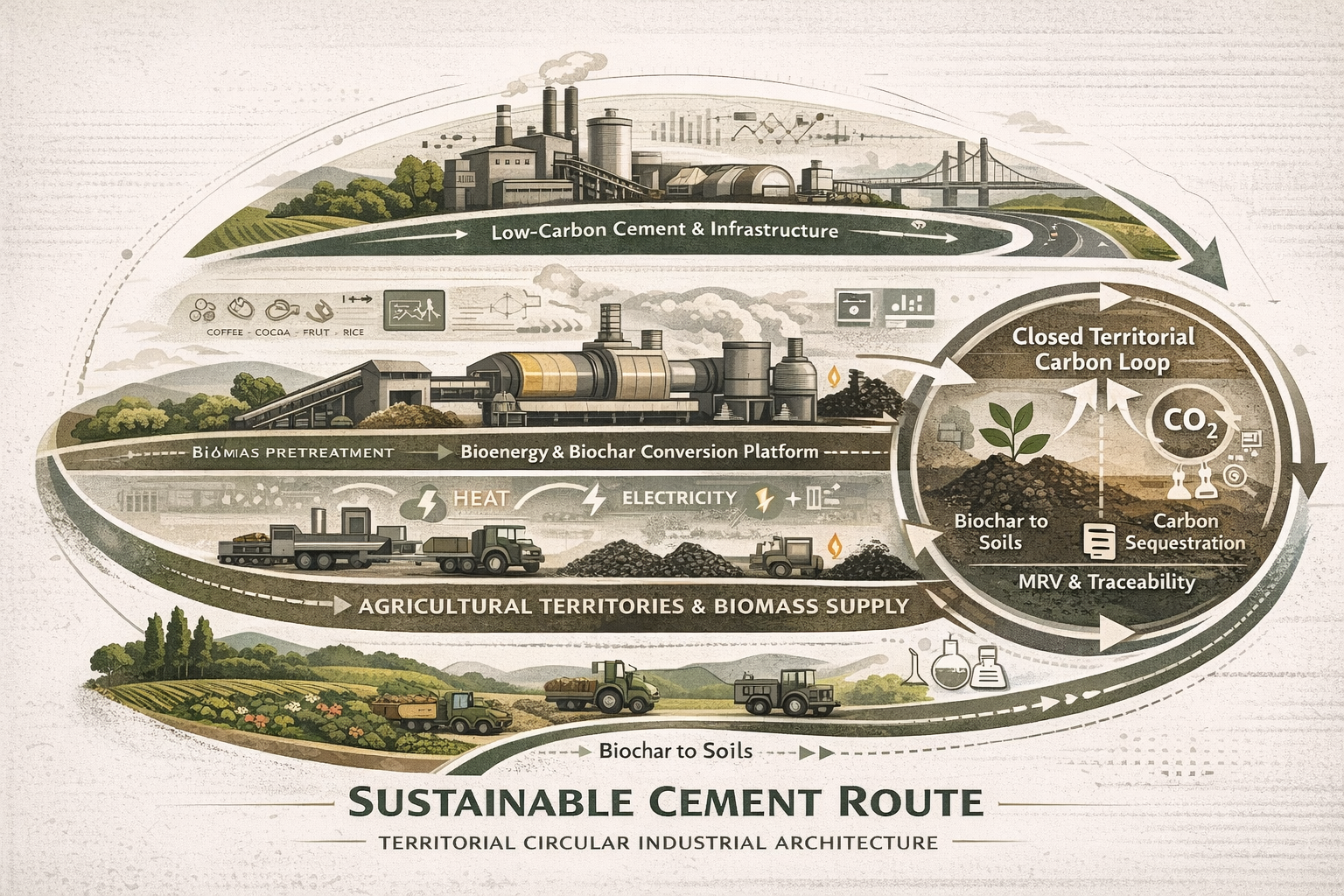
Technical Integration: From Biomass to Circular Value

Our engineered pathway transforms agricultural residues into low-carbon cement production and verifiable carbon assets—creating a closed-loop industrial ecosystem.

🌾
1

Biomass Supply

Agricultural residues sourced from certified rural networks (coffee, rice, palm).

⚙️
2

Pretreatment

Drying, grinding & torrefaction to stabilize biomass for thermochemical conversion.

🔥
3

Conversion

Optimized pyrolysis & gasification producing biochar and clean syngas.

🏭
4

Cement Integration

Syngas replaces fossil fuels in precalciner/preheater; raw material drying.

5

Energy Recovery

Waste Heat Recovery (WHR) systems generate electricity via ORC/steam cycles.

↻ CLOSED-LOOP RETURN
Biochar returns to soil and infrastructure, completing the circular economy
🌱
6

Biochar Application

Soil Regeneration
Long-term carbon sequestration + soil fertility
Agriculture
Reduced fertilizer & water requirements
Infrastructure
Road stabilization & construction materials

🔬 Technical Highlights

Process Integration
Syngas co-firing reduces fossil fuel consumption by 30–50% in cement kiln.
Carbon Value
Biochar enables durable carbon removal (CDR) credits + soil enhancement.
WHR Efficiency
ORC systems convert waste heat into on-site electricity.
MRV Ready
Integrated measurement, reporting & verification for carbon/ESG.

Technical Integration Architecture

1. Biomass Supply

Certified agricultural residues (coffee, rice, palm, mixed agro-residues).

2. Pretreatment

Drying, grinding, torrefaction.

3. Thermochemical Conversion

Optimized pyrolysis and gasification systems producing:
• Syngas for energy substitution
• Biochar for carbon sequestration

4. Cement Integration

Syngas injection in precalciner/preheater systems.
Raw material drying support.

5. Waste Heat Recovery (WHR)

Integration with ORC / steam cycle systems.

6. Biochar Application

• Soil regeneration
• Infrastructure stabilization
• Durable carbon removal (CDR)

For Cement Producers & Technology Partners

If you are evaluating biomass co-processing, waste heat recovery, or biochar integration in Latin America, Tierras de Montaña provides the de-risked, pre-structured platform for entry.
A full technical and commercial dossier, including financial modeling and project P&L, is available under mutual NDA.

A full technical and commercial analysis is available under a mutual confidentiality agreement.

Contact us for a strategic briefing