

Decarbonize your supply chain at origin
For Global Brands & Carbon Market Participant
We start with coffee — with a model designed to scale across all agricultural supply chains.
We are ready to work with your company to reduce Scope 3 emissions at origin, strengthening supply security and production resilience. Partnering with TDM provides a direct pathway to meeting climate commitments through high-integrity Insetting:
Why this is a win:
Scope 3 Reduction @ Source
Cut emissions directly where they are generated — within your own supply chain, not through offsets.
🤝 Secure Your Supply
Strengthen farmer productivity and soil health to protect long-term sourcing quality and volumes.
Full Traceability & MRV
Track every step — from biomass to verified carbon removal — with audit-ready data.
Ready for Regulation
Built to align with SBTi, CSRD, and evolving Scope 3 reporting requirements.
Our Mission
The Shift from Liability to Asset
What We Build
Industrial-Grade Infrastructure at Origin
We replace artisanal uncertainty with industrial stability. Deploying Industrial-scale systems designed for reliable, continuous operation directly within your supply chain.
🏗️ Modular Carbon Removal Hubs:
Integrated directly within production landscapes to process agricultural residues at the source.
🤝 Bankable Transparency:
Powered by real-time digital MRV (Monitoring, Reporting, Verification) to ensure every tonne of carbon removed is verifiable, permanent, and audit-ready.
♻️ Circular Utility
Recovering renewable thermal energy to decarbonize industrial processing (drying, roasting) while returning biochar to restore soil health
Supply Chain Security
Securing reliable biomass flows through territorial structuring and rural integration.
🌾 Territorial Anchoring
Active engagement with municipalities and farmer networks ensures long-term, structured access to agricultural residues.
📦 Feedstock Security
Pre-negotiated supply agreements eliminate upstream uncertainty and stabilize industrial input flows.
🤝 Social License
Integration with local communities guarantees operational continuity and alignment with rural development goals.
Clean Energy for Operations
Transforming biomass into energy and industrial outputs through validated technologies.
⚙️ Technology Integration
Deployment of fit-for-purpose systems validated with European R&D partners to ensure performance and scalability.
🏭 Industrial Coupling
Direct integration into industrial processes (cement, energy, materials) for immediate operational value.
🔬 Qualification & Pilots
Pilot validation platforms reduce technical risk before large-scale deployment.
Certified Carbon Impact
Converting industrial activity into certified carbon assets and structured revenue streams.
📊 Carbon Asset Creation
Development of measurable, verifiable carbon outputs aligned with international standards.
📈 Market Access
Connection to voluntary and compliance carbon markets through structured offtake strategies.
🧾 MRV Infrastructure
Robust Measurement, Reporting and Verification systems ensuring transparency and bankability.
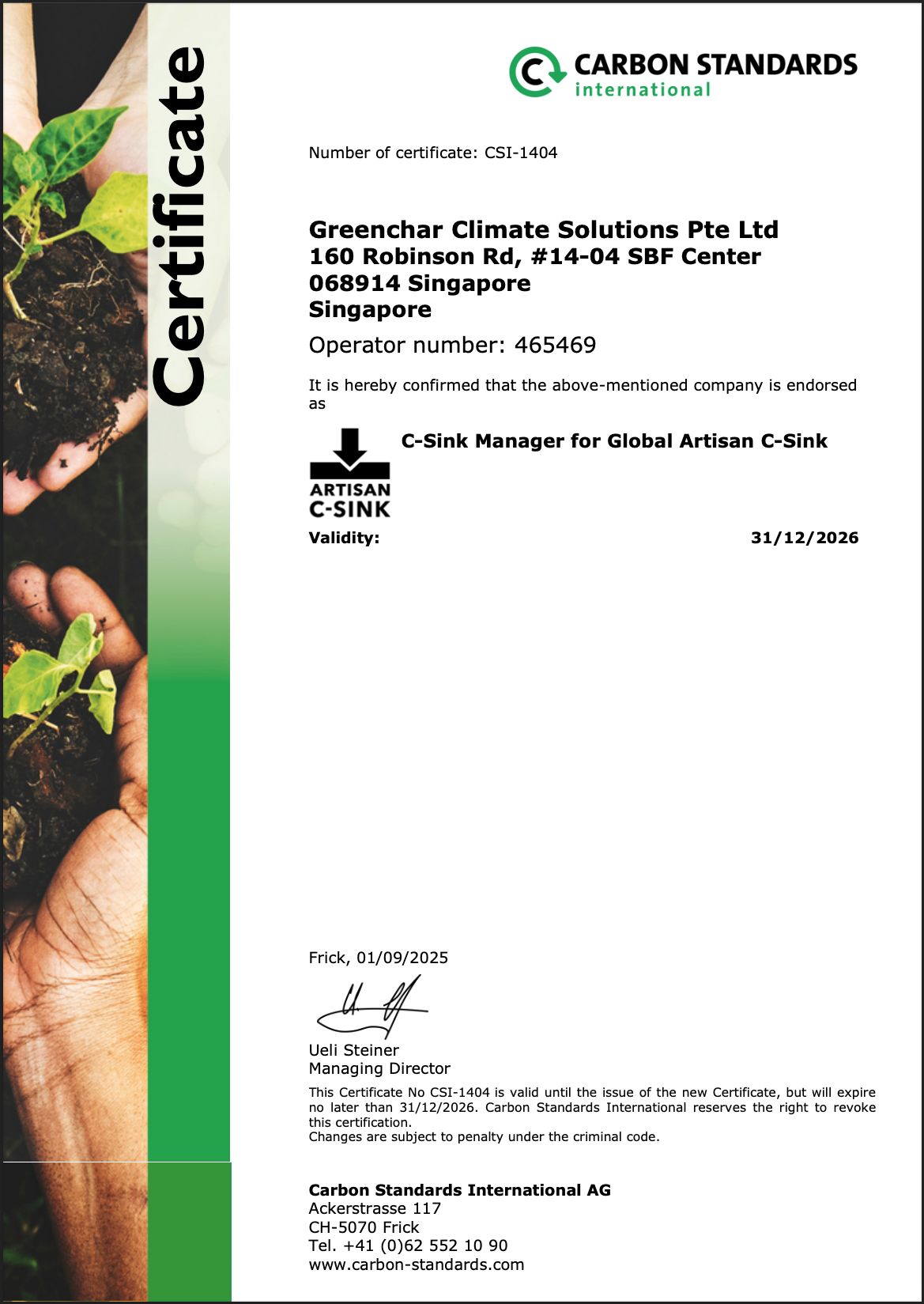
Powered by Greenchar Climate Solutions. Certified C-Sink Manager with Carbon Standards International (CSI).


Definition: EU regulation requiring companies to measure and report environmental impact.
👉 Audit-ready data, reduced compliance risk.
Definition: Framework for setting science-based emission reduction targets.
👉 Real reductions, not just commitments.
Definition: Emissions from operations (1), energy (2), and supply chain (3).
👉 Focus where impact is highest: supply chain.
Definition: Monitoring, Reporting, and Verification of carbon impact.
👉 Reliable, traceable, audit-ready data.
Definition: Biomass converted into stable carbon stored in soil.
👉 Waste becomes carbon asset + soil improvement.
Definition: European standard for biochar quality and traceability.
👉 Trusted, high-integrity carbon impact.
Definition: Reducing emissions within your own supply chain.
👉 Stronger supply + direct impact.
Definition: Compensating emissions outside your operations.
👉 Does not transform your supply chain.
Vision
Scaling the Regenerative Engine
By enabling brands to act directly on Scope 3 emissions at origin, we turn sourcing regions into regenerative engines — where climate performance, soil health, and supply resilience grow together. We don’t just compensate. We regenerate.
We don’t just compensate. We regenerate.
Start a Scope 3 Pilot
Click the button to request deck via WhatsApp