

1. The Colombian Context: from Waste to Resource
The Challenge: Coffee Pulp
Colombia generates millions of tons of coffee pulp annually.
This residue, with 80% moisture and high acidic content,
is currently an environmental liability: it contaminates rivers, generates methane (GHG) and
acidifies soils in coffee-growing regions.
The Opportunity
That same pulp is an exceptional carbon reservoir.
Transforming it into high-purity biochar (Cfix >80%) not only solves the
ecological problem but also turns cooperatives into biorefineries
generating climate and economic value.
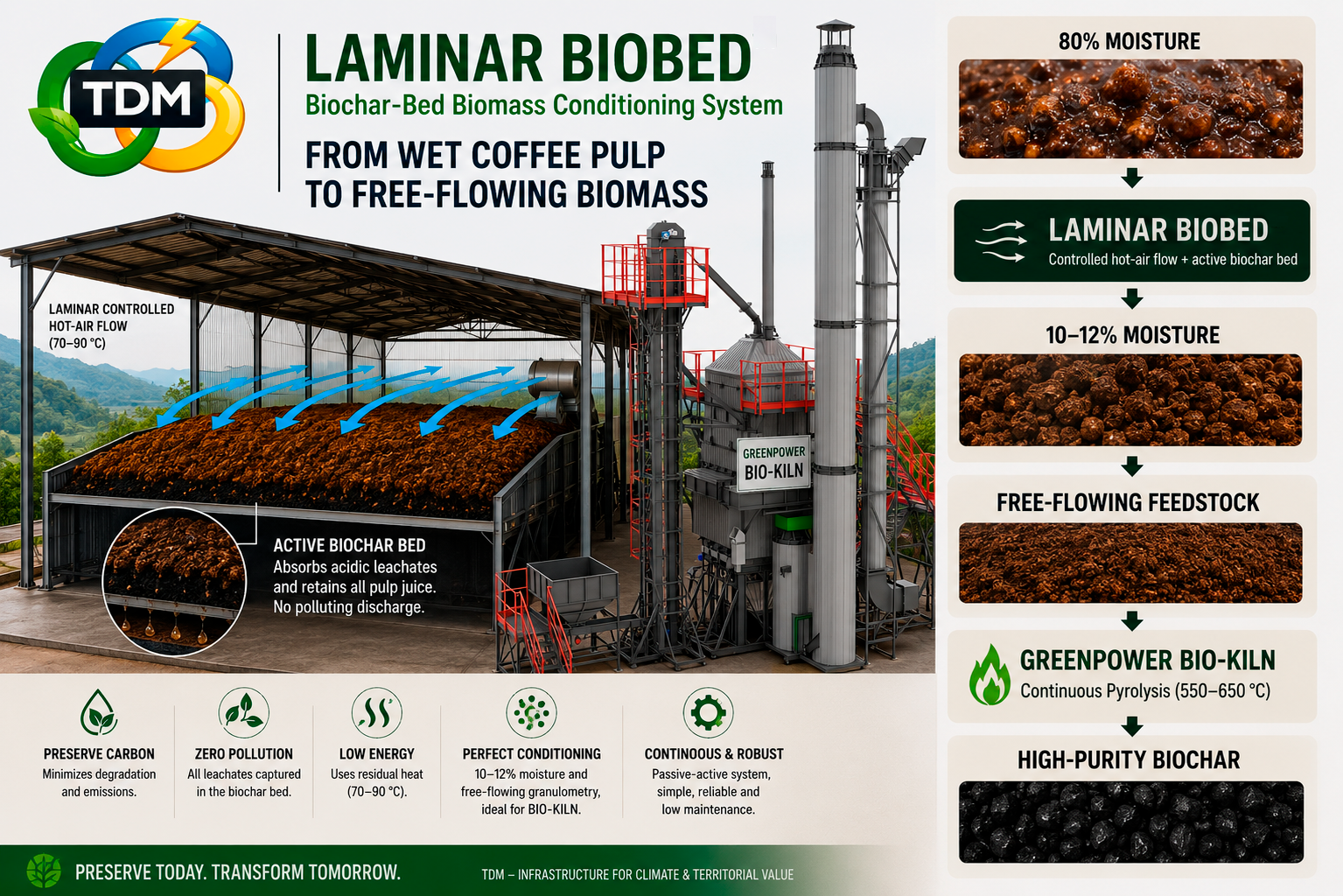
2. Pulp Preparation: Drying with Laminar Flow Marquee
The Drying System
- Protective active biochar bed: Absorbs acidic leachates and becomes enriched with nutrients.
- Residual hot air injection (70‑90 °C) from the ORC cooling circuit.
- The pulp reaches a stable moisture content of 10‑12%, losing its sticky nature.
- Zero polluting leachate: all the pulp juice is retained in the lower biochar layer.
Result
The dried pulp acquires a fluid granulometry (similar to nutshells),
ideal for the vertical gravitational flow of the BIO‑KILN. No blockages or agglomerations.
✅ Technical validation: The system has been validated in complex logistical contexts (Ukraine)
and adapts perfectly to Colombian tropical conditions.
3. Continuous Carbonization: the Heart of the Project
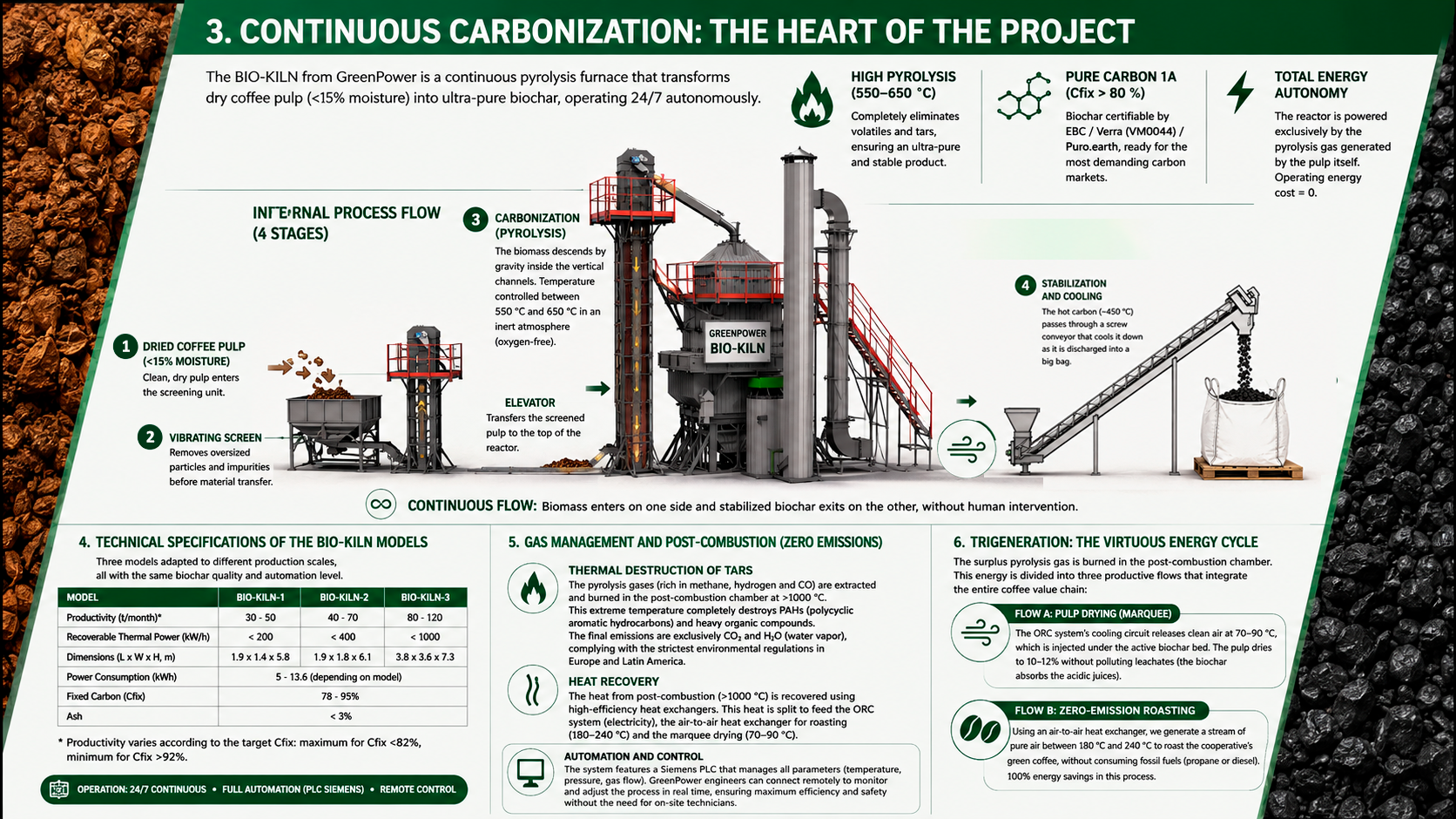
The BIO‑KILN from GreenPower is a continuous pyrolysis furnace that transforms
dry biomass (<15% moisture) into ultra-pure biochar, operating 24/7 autonomously.
🔥 High Pyrolysis (550‑650 °C)
Completely eliminates volatiles and tars, ensuring an ultra-pure and stable product.
🧪 Pure Carbon 1A (Cfix > 80 %)
Potential certification / carbon-market pathways
*EBC *Puro.earth *Verra VM0044
*Independent laboratory characterization
*MRV development.
Final eligibility and certification depend on feedstock, process parameters, laboratory results and applicable methodology requirements.
⚡ Thermal self-sufficiency.
The reactor is thermally self-sustained using the pyrolysis gas generated by the biomass, minimizing external fuel requirements.
Internal Process Flow (4 Stages)
🌾 1. Deagglomeration and Screening
The dried pulp (10‑12% moisture) is crumbled to break agglomerates and screened to remove impurities. Its natural particle size (<15 mm) already meets the BIO‑KILN input range (<40 mm). No industrial grinding required.
🌡️ 2. Integrated Drying
Residual heat is injected to adjust the moisture to 10-12% just before entering the reactor.
🔥 3. Carbonization (Pyrolysis)
The biomass descends by gravity inside the vertical channels. Temperature controlled between 550 °C and 650 °C in an inert atmosphere (oxygen-free).
❄️ 4. Stabilization and Cooling
The hot carbon (>450 °C) passes through a forced cooling system (refrigerated screw conveyor) to prevent oxidation upon contact with air.
♻️ Continuous flow: Biomass enters on one side and stabilized biochar exits on the other, without human intervention.
4. Technical Specifications of the BIO‑KILN Models
Three models adapted to different production scales, all with the same biochar quality and automation level.
| Model | BIO-KILN-1 | BIO-KILN-2 | BIO-KILN-3 |
|---|---|---|---|
| Productivity (t/month)* | 30 – 50 | 40 – 70 | 80 – 120 |
| Recoverable Thermal Power (kWth) | < 200 | < 400 | < 1000 |
| Dimensions (L x W x H, m) | 1.9 x 1.4 x 5.8 | 1.9 x 1.8 x 6.1 | 3.8 x 3.6 x 7.3 |
| Power Consumption (kWh) | 5 – 13.6 (depending on model) | ||
| Fixed Carbon (Cfix) | 78 – 95% | ||
| Ash | < 3% | ||
* Productivity varies according to the target Cfix: maximum for Cfix <82%, minimum for Cfix >92%.
⚙️ Operation: 24/7 continuous · Full automation (PLC Siemens) · Remote control.
5. Controlled Post-Combustion & Thermal Destruction
Thermal Destruction of Tars
- The pyrolysis gases (rich in methane, hydrogen and CO) are extracted and burned in the post-combustion chamber at >1000 °C.
- This extreme temperature completely destroys PAHs (polycyclic aromatic hydrocarbons) and heavy organic compounds.
- The post-combustion stage is designed to thermally destroy tars and heavy organic compounds, with emissions subject to applicable monitoring and regulatory requirements.
Heat Recovery
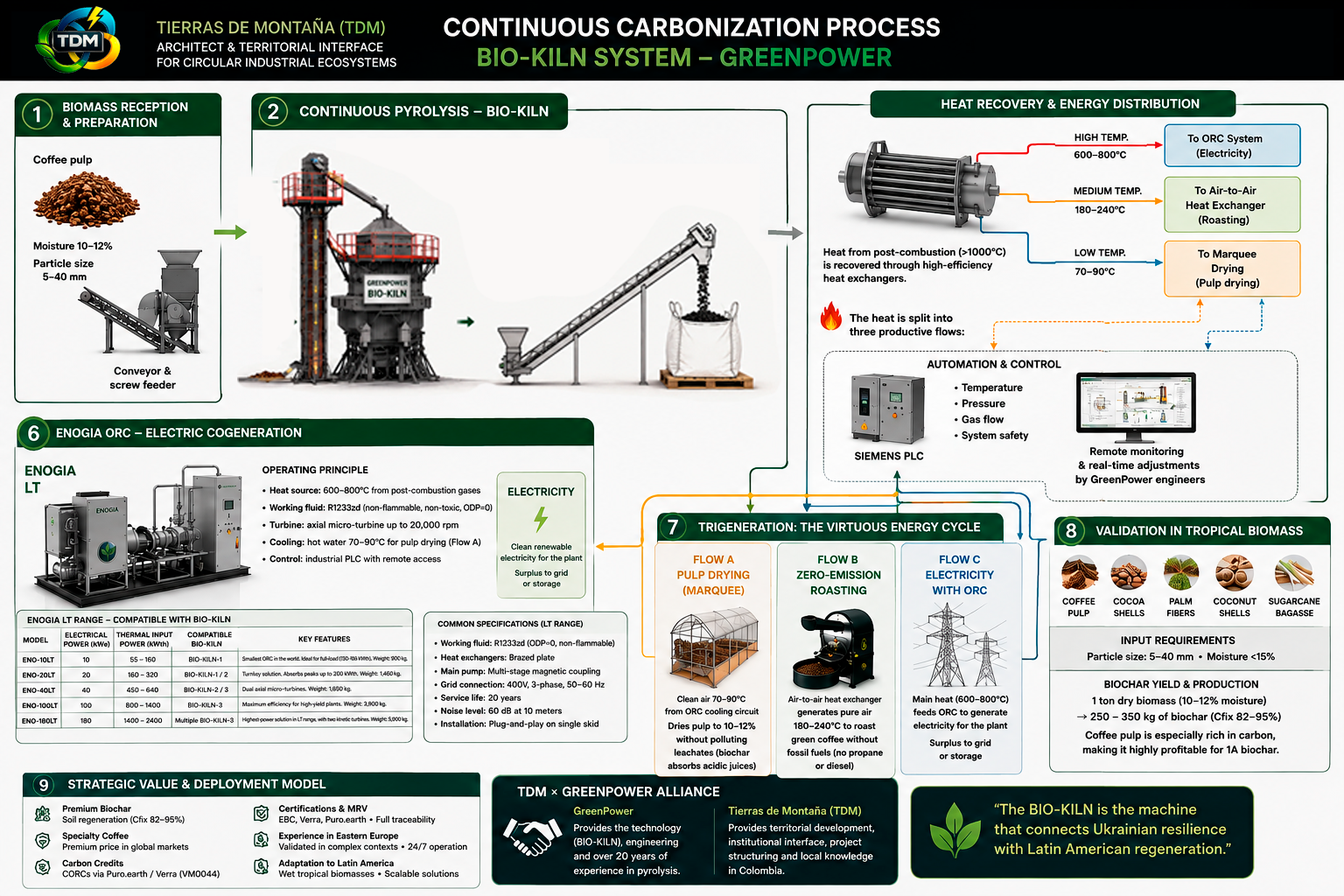
- The heat from post-combustion (>1000 °C) is recovered using high-efficiency heat exchangers.
- This heat is split to feed the ORC system (electricity), the air-to-air heat exchanger for roasting (180-240 °C) and the marquee drying (70-90 °C).
🤖 Automation and Control: The system features a Siemens PLC that manages all parameters (temperature, pressure, gas flow).
GreenPower engineers can connect remotely to monitor and adjust the process in real time, ensuring maximum efficiency and safety without the need for on-site technicians.
6. ENOGIA ORC – Electric Cogeneration
The ORC (Organic Rankine Cycle) system is the core of the plant’s power generation.
It converts the residual heat from post-combustion (>1000 °C) into clean, renewable electricity,
making the most of the energy contained in the pyrolysis gases.
🔧 Operating Principle
- Heat source: Hot gases (600‑800 °C) from the post-combustion chamber.
- Working fluid: R1233zd (non-flammable, non-toxic, ODP=0).
- Turbine: High-speed axial micro-turbine (up to 20,000 rpm) with permanent magnets.
- Cooling: The ORC circuit itself generates hot water (70‑90 °C) for pulp drying (Flow A).
- Control: Industrial PLC with remote web access.
⚡ Synergy with the BIO‑KILN
- Energy autonomy: The ORC runs exclusively on residual heat, with no additional fuel.
- High overall heat utilization through integrated drying, roasting and ORC recovery..
- Emission reduction: Each kWh generated avoids burning fossil fuels on the grid.
Compatible ENOGIA LT Models for each BIO‑KILN
The selection of the ORC model depends on the actual recoverable thermal power, which itself is determined
by the target biochar purity (Cfix >80%). The values shown correspond to operation with coffee pulp.
| ORC Model | Electrical Power (kWe) | Thermal Input Power (kWth) | Compatible BIO‑KILN | Key Features |
|---|---|---|---|---|
| ENO‑10LT | 10 kWe | 55 – 160 | BIO‑KILN‑1 | The smallest ORC in the world. Ideal for full-load operation (150‑160 kWth). Weight: 900 kg. |
| ENO‑20LT | 20 kWe | 160 – 320 | BIO‑KILN‑1 / BIO‑KILN‑2 | “Turnkey” solution. Absorbs peaks up to 200 kWth. Weight: 1,460 kg. |
| ENO‑40LT | 40 kWe | 450 – 640 | BIO‑KILN‑2 / BIO‑KILN‑3 | Dual axial micro-turbines. Weight: 1,650 kg. |
| ENO‑100LT | 100 kWe | 800 – 1400 | BIO‑KILN‑3 | Maximum efficiency for high-yield plants. Weight: 3,900 kg. |
| ENO‑180LT | 180 kWe | 1400 – 2400 | Multiple BIO‑KILN‑3 | The highest-power solution in the LT range, with two kinetic turbines. Weight: 5,900 kg. |
Note: The thermal input powers correspond to the ORC’s nominal operating range.
For the BIO‑KILN‑1 with coffee pulp and Cfix >80%, the actual available power is <200 kWth,
making the ENO‑10LT or ENO‑20LT the most suitable options.
Common Technical Specifications (LT Range)
- Working fluid: R1233zd (ODP=0, non-flammable).
- Heat exchangers: Brazed plate.
- Main pump: Multi-stage magnetic coupling.
- Control: PLC with remote web access.
- Grid connection: 400V, three-phase, 50‑60 Hz.
- Service life: 20 years.
- Noise level: 60 dB at 10 meters.
- Installation: Plug‑and‑play system on a single skid.
💡 Selection for the pilot project: For a BIO‑KILN‑1 operating with coffee pulp and producing 1A biochar (Cfix >80%),
the recoverable thermal power ranges between 150 and 200 kWth. In this scenario, the ENO‑10LT (55‑160 kWth)
will operate at full load, while the ENO‑20LT (160‑320 kWth) provides margin for production peaks.
Both options are viable; the final decision will depend on the expected load profile.
7. Trigeneration: the Virtuous Energy Cycle
The surplus pyrolysis gas is burned in the post-combustion chamber. This energy is divided into three productive flows that integrate the entire coffee value chain:
🔥 Flow A: Pulp Drying (Marquee)
The ORC system’s cooling circuit releases clean air at 70‑90 °C,
which is injected under the active biochar bed. The pulp dries to 10‑12%
without polluting leachates (the biochar absorbs the acidic juices).
☕ Flow B: Zero-Emission Roasting
Using an air-to-air heat exchanger, we generate a stream of pure air between 180 °C and 240 °C
to roast the cooperative’s green coffee, without consuming fossil fuels
(propane or diesel). Elimination of fossil-fuel consumption for roasting.
⚡ Flow C: Electricity with ORC System
The main heat (600‑800 °C) feeds an ORC (Organic Rankine Cycle) module that generates
the electricity needed for the entire plant (fans, motors, pumps, lighting).
The surplus can be injected into the local grid or stored.
8. Validation in Tropical Biomass and Yield
Approved Biomasses
- Coffee pulp (requires prior drying to 10‑12% using the marquee).
- Cocoa, palm, coconut, sugarcane husks and nutshells.
- Input requirements: particle size 5‑40 mm and moisture <15%.
Biochar Yield and Production
For each 1 ton of dry biomass (at 10‑12% moisture), the BIO‑KILN produces between
250 and 350 kg of pure biochar (Cfix 82‑95%), depending on the density and composition
of the raw material.
🌱 Note: Coffee pulp is especially rich in carbon, making it one of the
most profitable raw materials for producing 1A biochar.
9. Strategic Value & Deployment Model
🌱 Premium Biochar
Sales to cooperatives and farmers for soil regeneration (Cfix 82‑95%).
☕ Specialty Coffee
Roasted with clean energy, negative carbon footprint. Premium price in international markets.
💳 Carbon Credits
CORCs via Puro.earth / Verra (VM0044) at prices.
✅ Certifications and MRV
We work with an approved and independent network of partners to guarantee the traceability, quality and commercialization of biochars:
- Certification seals: EBC (European Biochar Certificate), Verra (VM0044) and Puro.earth.
- Monitoring, Reporting and Verification (MRV): Robust and auditable protocols.
- Partner laboratories: Analysis of fixed carbon, heavy metals, PAHs and BET surface area.
- Total traceability: From biomass to final product.
🇺🇦 Experience in Eastern Europe
- Technology validation in complex logistical contexts.
- Biochar as a soil stabilization tool.
- 24/7 operating models with minimal human intervention.
🌿 Adaptation to Latin America
- Wet tropical biomasses (coffee, cocoa, palm, sugarcane).
- Cogeneration models (ORC) and biochar for productive transition.
- Scalability from pilot projects to industrial plants.
🤝 TDM × GreenPower Alliance
- GreenPower → Provides the technology (BIO‑KILN), engineering and over 20 years of experience in pyrolysis.
- Tierras de Montaña (TDM) → Provides territorial development, institutional interface, project structuring and local knowledge in Colombia.
“The BIO‑KILN is the machine that connects Ukrainian resilience with Latin American regeneration.”
📅 Next Concrete Step
Let’s define the schedule,
technical specifications of the BIO‑KILN and the roadmap for the pilot project
in a Colombian coffee cooperative.
Are you a public institution, a cooperative or an investor? Contact us.