

ORIGEN — Experimental Protocol for the Laminar Biobed
Preparation, testing, and validation of a coffee pulp preservation device
VERSION: TDM-ORIGEN-PROTO-BIOBED-2026-01 (October 26, 2026)
STATUS: Provisional validation protocol. No tests performed. No performance, capacity, or lifespan is validated prior to measurement.
SCOPE: Working document. It does not constitute an execution plan, an engineering validation, or an investment authorization.
NORMATIVE REFERENCE: This document is subordinate to the TDM Master Standard v1.0, which prevails in case of divergence.
B. Operational Summary
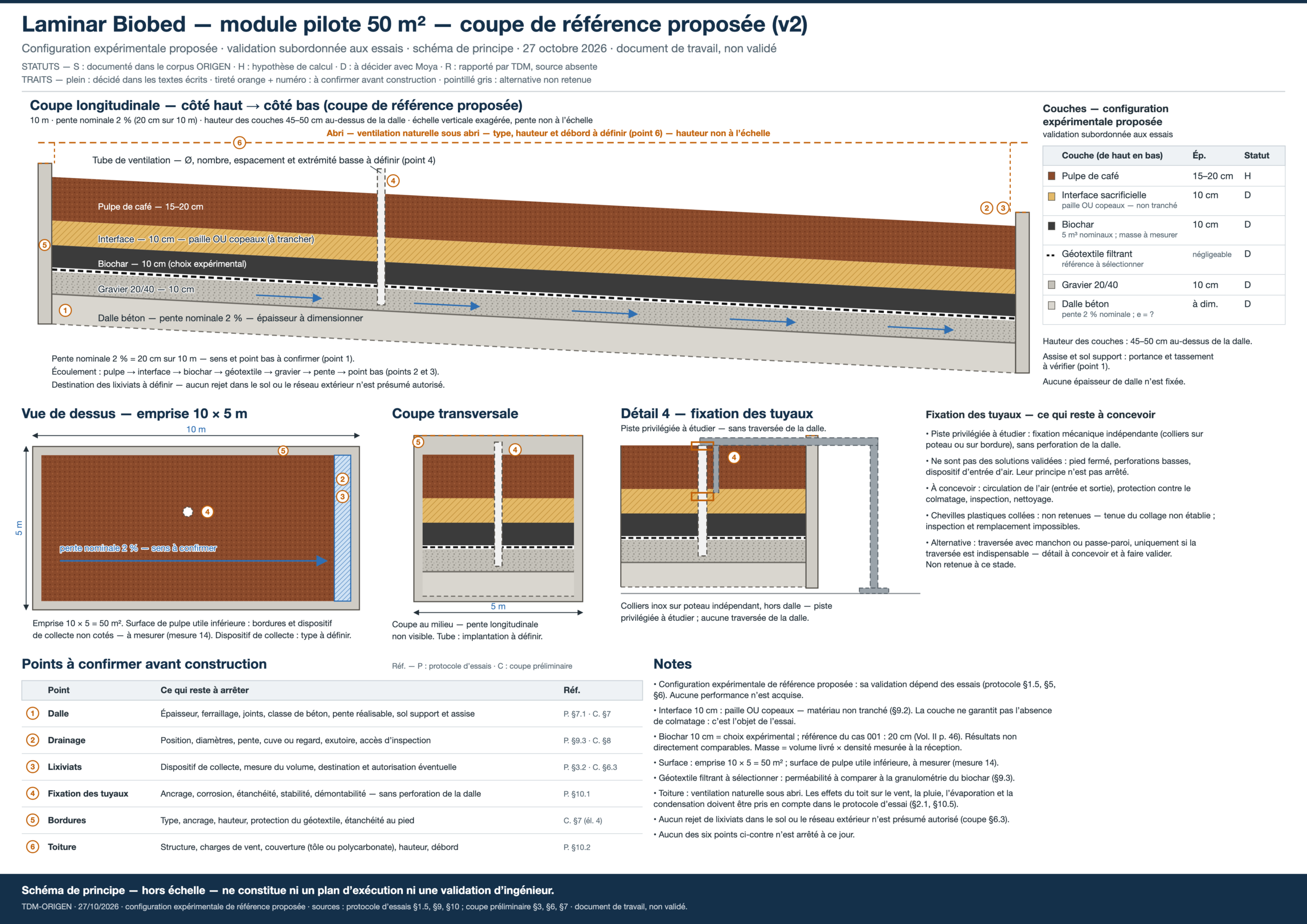
Central question: Can wet coffee pulp be preserved and conditioned under the real conditions of Planadas using a ventilated biochar bed, without uncontrolled degradation?Reference technical concept: A proposed architecture comprising several functional layers (slab, gravel, geotextile, biochar, interface, pulp), whose composition, geometry, and hydraulic performance still need to be verified.
Dimensioning: The 50 m² format is a hypothesis for further development. It will only be retained after exploratory tests, results analysis, and verification of site constraints.
Blocking conditions: Lack of rain protection, sealing defect, lack of reliable measuring instruments, or insufficient operator training.
C. Function of the Laminar Biobed in ORIGEN
The Laminar Biobed is a passive preservation infrastructure. It is neither an industrial dryer nor a transformation reactor.- Preservation: Study the device's ability to reduce water content and limit conditions favorable to anaerobic degradation.
- Conditioning: Make the material more homogeneous and easier to handle prior to thermochemical transformation (pyrolysis).
- Transformation: Subsequent stage (BIO-CARBON-2) which is not studied here.
D. Technical Reference Diagram (V2)
 Enlarge
E. Implementation Variants
The Master Standard specifies that the concrete slab is a reference solution to be studied, not a universal obligation. Two options must be examined: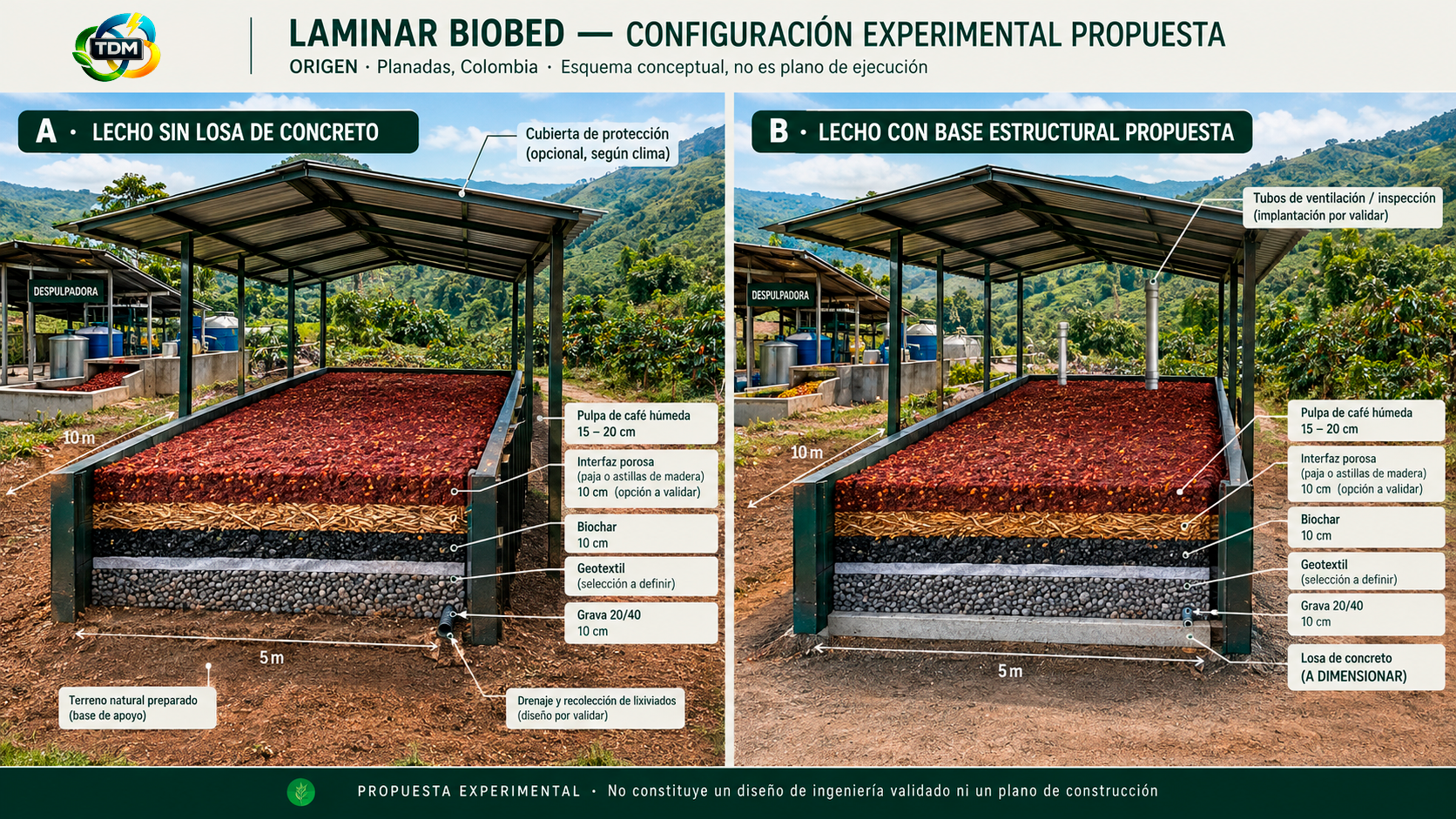 Enlarge
Scientific Explorations ORIGEN
Applied research notebooks on biomass preservation. Understanding the material before designing the process.
The Problem: Pulp Doesn't Read Diagrams
Fresh coffee pulp is not an inert material. Its high water content, organic composition (sugars, pectins, mucilage), and consistency evolve during drying. Depending on the conditions, it can compact, form agglomerates, or develop an impermeable crust that hinders air exchange.
The engineering question: How can we maintain a sufficiently porous structure for water to evacuate, air to circulate, and the material to remain recoverable?
At the Coffee Expo (October 2026), Alejandro C., CEO of a major coffee exporter, asked a very concrete question:
"When drying, the pulp forms glue balls. How are you going to process them?"
This observation validates the technological bottleneck. It's not enough to remove water: we must understand the rheology of the material to prevent compaction.
Study 1: Drying Kinetics and Behavior
Hypothesis: Drying the pulp generates a moisture gradient that creates a surface crust, blocking internal evaporation.
- Water Evacuation: Quantify mass transfer (evaporated water vs. residual water).
- Crust Formation (Crusting): Observe if the surface dries too quickly, trapping moisture inside.
- Mechanical Evolution: Measure settling and adhesion force to the support.
Study 2: Porosity Modification by Structuring Agents
Hypothesis: Adding a structuring agent (fibers, husks) creates a macropore network that maintains air permeability even under compression.
- Coffee Husk (Cisco): Locally available, to be tested for rigidity and absorption.
- Straw or Wood Chips: Potential for forming an open structure in the long term.
- Biochar: Highly porous, but its mechanical behavior in a wet mixture must be verified (do not presume its effectiveness).
Solution A: Mechanical Dewatering (Pressing)
Pressing is a documented physical pretreatment. It aims to extract a fraction of free water and mucilaginous substances before drying.
What science says: A 1980 study confirms that the extracted juice contains a large portion of extractable sugars. The 1991 thesis confirms the value of a two-stage process (mechanical dewatering then drying).
What must be measured in Planadas: The actual moisture of the pressed cake, the mass of extracted juice, and the resulting drying time. The often-cited reduction factor of 6 to 8 is not a universal guarantee.
Solution B: Structuring and Densification
Hypothesis to test: If the pulp retains a tendency to settle or agglomerate after pressing, adding a structuring material could improve air circulation and facilitate recovery.
Proposed comparison:
- Control: Pulp alone (natural behavior).
- Variant 1: Pulp + Coffee husk (local fibrous material).
- Variant 2: Pulp + Biochar (only as a comparative option).
- Variant 3: Pressed pulp + structuring agent (if early results justify it).
No material will be retained on principle. Biochar added to the pulp must not be confused with the biochar used as a filter layer in the Laminar Biobed, nor with the biochar produced by pyrolysis. Its incorporation into the pulp remains a research hypothesis to improve rheology, not an ORIGEN process prescription.
2. Densification (Post-drying): To ensure a regular feed for the BIO-CARBON-2 pyrolyzer, the dried (and crushed if necessary) pulp can be densified into briquettes with a binder.
From Concept to Industrial Validation
The ORIGEN program rejects the construction of a "white elephant." Industrial dimensioning is conditional on the validation of the following stages:
- Documentation: Strict scientific literature review (Pressing, drying, densification).
- Characterization: Physicochemical analysis of Planadas pulp (moisture, pectins, sugars).
- Pilot Tests (1 m²): Setup of comparative bins with controls and repetitions.
- Measurements: Monitoring mass loss, permeability, and shear resistance.
Ready to scale industrially?
We are looking for financial and technical partners to co-finance the pilot phase and the installation of BIO-CARBON-2 in Planadas.
Discuss the Pilot Project