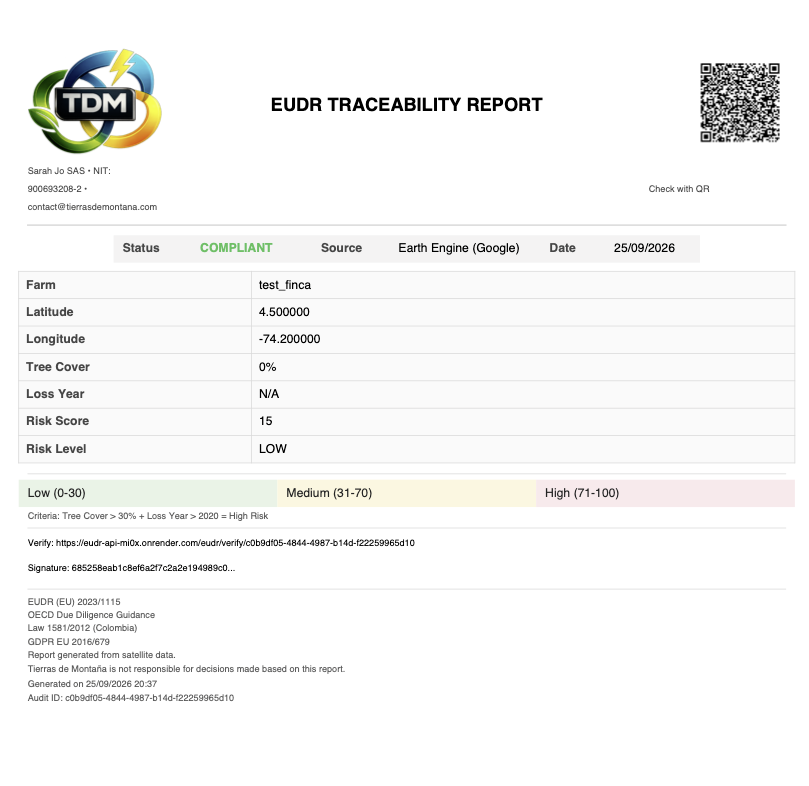
Connecting territories with the capabilities they need to endure.
Territorial architecture & institutional interface for the Americas
TDM is a Colombian institutional platform connecting local communities and productive territories with global capabilities — technology, engineering, capital and governance.
We do not replace territories. We do not replace technology. We connect them.
The gap is not technology. The gap is connection.
Territories generate immense value — biomass, carbon, nutrients, water, community resilience. Most of it is lost before transformation even begins. Not because technology is missing. Because the infrastructure to connect, preserve and coordinate is missing.
We are the bridge.
TDM does not replace local territories. We do not replace technology vendors. We build and operate the infrastructure that connects them — across legal, technical, logistical and institutional dimensions.
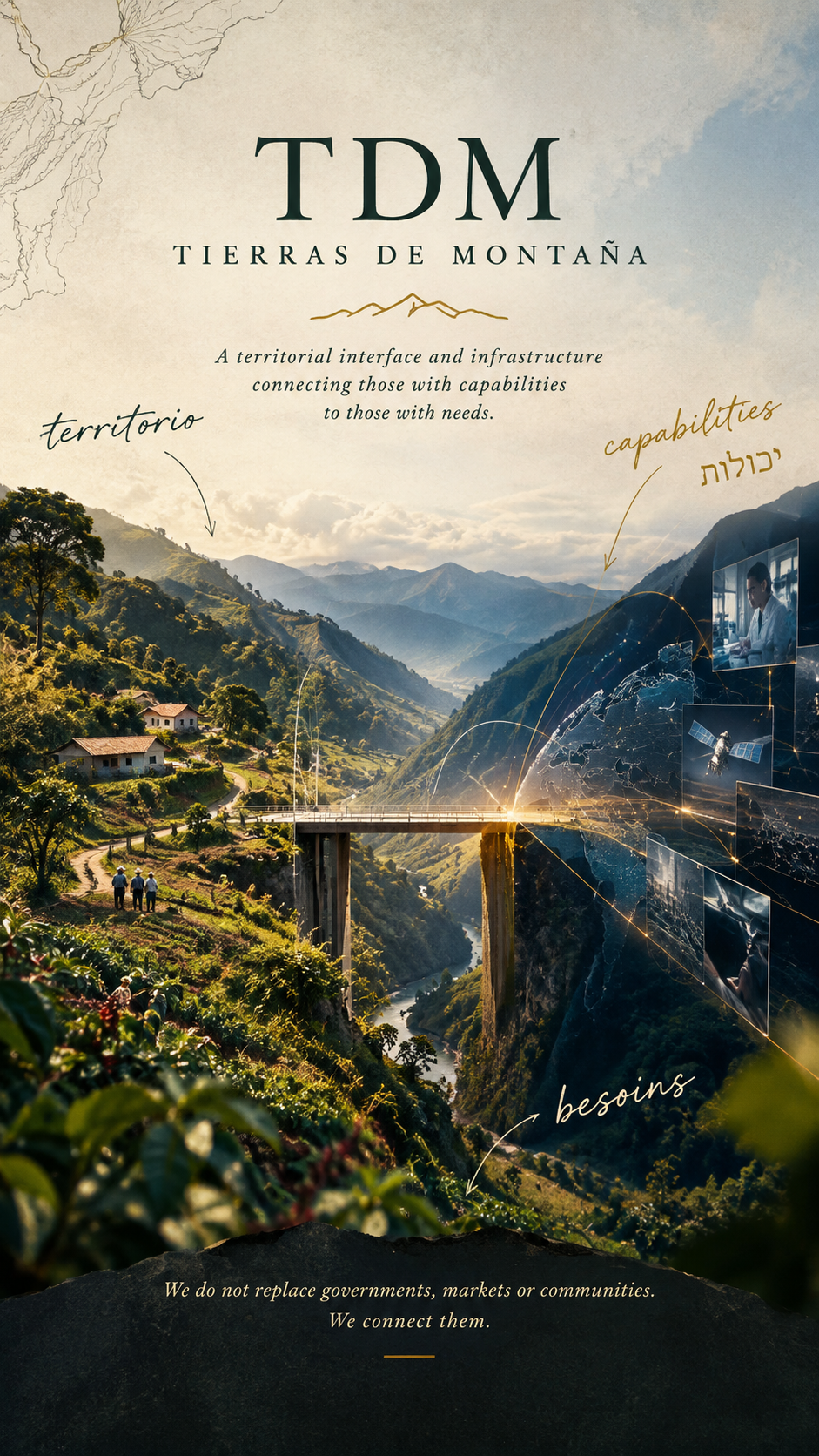
Bank I Territories
Needs & Resources
- 480+ coffee-producing families
- 3,000 hectares under sustainable management
- Biomass, carbon, nutrients & water
- Local & indigenous governance structures
- Producer associations & cooperatives
Preservation Layer · ORIGEN Protocols · EUDR Traceability · Constitutional Framework · Strategic Agreements
The bridge does not own either bank.
It connects them.
Bank II Capabilities
Technology & Capital
- Continuous pyrolysis & ORC engineering
- International MRV & carbon certification
- Industrial Scope 3 decarbonization
- Bilateral institutional cooperation
- Climate finance & impact capital
An institutional platform. Not a project developer.
TDM is a Colombian territorial architect and industrial interface for circular systems.
TDM begins with territory — connecting communities, producers, government, resources and needs, and building around them the architecture, partnerships and pathways required for execution.
TDM is not an EPC company, not a technology vendor, not a plant operator. Its role is to connect territory with the right technology, industry, research and institutions, and to coordinate the transition from designed system to deployment.
Technology is not the starting point.
Territory is.
Registered operator: SARAH JO S.A.S. — Bogotá, 2014 · DIAN Importer/Exporter · Federación Nacional de Cafeteros · Customs & freight network · EUDR App developer.
Preservation precedes technology.
Biological Capital degrades within hours of harvest. Carbon mineralises. Nutrients leach. Water becomes weight. Most biomass value is lost before transformation even begins.
What is lost
- Carbon — mineralised rapidly to CO₂ and CH₄
- Nutrients — N, P, K leached into water runoff
- Structure — compaction, loss of handling integrity
- Energy — chemical potential dissipated as heat
The critical window
- 0–24 h — fermentation and heating begin
- 24–72 h — heavy leachate and nutrient loss
- 3–7 days — structural breakdown, compaction
- > 7 days — irreversible carbon mineralisation
Our field response
- Passive preservation infrastructure at origin
- Gravity, natural ventilation, thermal convection
- Low-cost, low-maintenance, locally built
- 82% → 22% moisture in 5–7 days
The Preservation Layer is not a preparatory step. It is the first act of infrastructure. It stabilises biomass, captures leachates, preserves carbon and nutrients — and it makes every downstream technology viable.
“No reactor, however advanced, can compensate for poor feedstock.”
From local resources to global capabilities.
An integrated architecture routing global technology, capital and institutions directly into validated territorial needs.
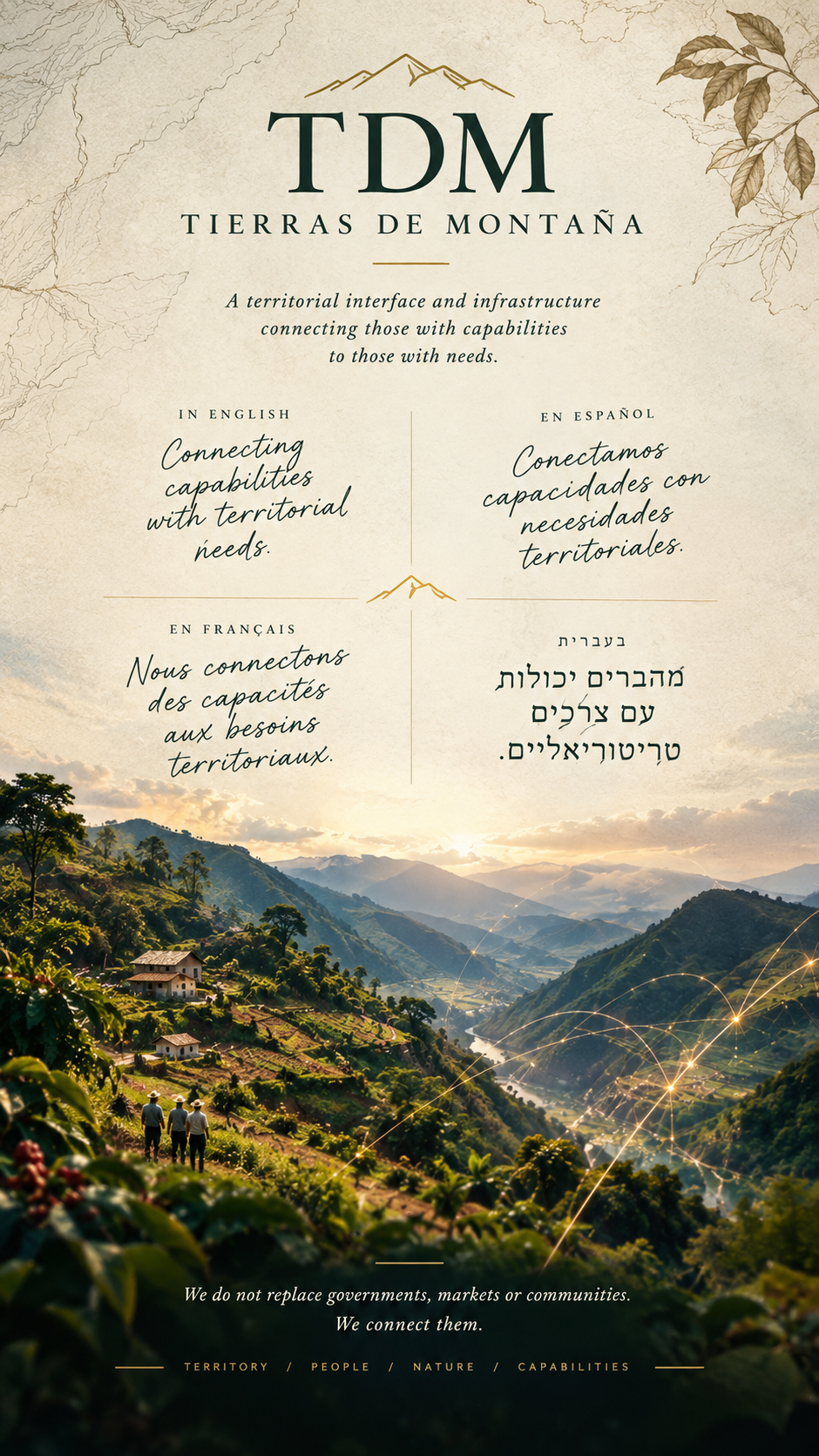
Six institutional pathways.
TDM operates as the territorial interface for international actors seeking structured, long-term cooperation in Latin America. Select the pathway that matches your role.
Deploy your technology in the Americas
Connect AgTech, continuous pyrolysis, ORC energy or water treatment equipment directly with secured feedstock, local operators and legal coverage through SARAH JO S.A.S.
Structure local supply and decarbonization
Secure traceable biomass, decarbonize Scope 3 agricultural supply chains and execute long-term circular supply agreements backed by local coffee networks.
Access bankable territorial assets
Bypass uncoordinated projects. Access a structured pipeline of biochar, renewable energy and carbon removal assets with verified local execution capability.
Validate protocols in real ecosystems
Connect scientific protocols with active productive territories. Validate MRV methodologies, tropical soil impacts and biomass conversion with high-integrity field data.
Originate high-integrity carbon assets
Develop traceable biochar and CDR credits backed by full digital traceability via the TDM EUDR App, regulatory alignment and verified community co-benefits.
Bilateral institutional cooperation
Utilize TDM as a vetted territorial interface to enable technology transfer, commercial partnerships and sovereign cooperation frameworks between jurisdictions.
What already exists.
TDM is not a concept. It is an institution with operational infrastructure, territorial presence, signed partnerships and a constitutional framework — already in place.
SARAH JO S.A.S.
- Bogotá — 12 years of operation
- DIAN-registered importer/exporter
- Federación Nacional de Cafeteros member
- Customs agency & selective freight network
ORIGEN Protocol
- Vol. I — Blueprint
- Vol. II — Preservation Layer
- Vol. III — Transformation Layer
- Master Technical Baseline v1.1
EUDR Platform
- Documentation tool for EUDR compliance
- Used with international MRV partners
- Geolocation & biomass chain-of-custody
Planadas — Tolima
- 480 coffee-producing families
- 3,000 hectares under sustainable management
- Signed LOIs with municipality & associations
- Coordination with indigenous governance
International Network
- Engineering partner — BIO-KILN framework agreement
- MRV partner — carbon verification MOU
- European industrial partner — signed NDA
- International research cooperation
Institutional Framework
- Constitutional Charter
- Strategic Partnership Manual
- Executive Partner Brief
- Alliance Framework — NDA-governed access
A structured six-step pathway.
From first alignment to industrial deployment.
Identify
Capability, technology or industrial requirement.
Match
Territorial alignment with resources and local governance.
Structure
Technical, legal and operational architecture definition.
Develop
Preservation & transformation infrastructure pilots.
Verify
MRV data capture, EUDR compliance and performance audits.
Scale
Capital expansion, replication and market delivery.
Institutional inquiries.
For cooperation, research initiatives, technology integration or investment mandates.
Direct communication with executive leadership. Managed under institutional protocols.
A1 Territorial Base
Restricted Access
Letters of intent and territorial agreements signed with Colombian producer communities, municipalities and associations.
Access is granted under the TDM Alliance Framework, subject to NDA and verification of institutional purpose.
Request Institutional Access →A2 Institutional Evidence
Restricted Access
Official filings and communications with Colombian government ministries, including reference numbers and institutional correspondence.
Access is granted under the TDM Alliance Framework, subject to NDA and verification of institutional purpose.
Request Institutional Access →A3 International Network
Restricted Access — NDA Required
Signed international agreements including master cooperation frameworks, MOUs and NDAs with engineering and carbon verification partners.
These documents are protected under the TDM Alliance Framework. Access is granted only under approved institutional NDA.
Request Institutional Access →A4 Chronology & Evidence
How we got here — from the initial territorial base to the TDM Colombia 2035 cooperation architecture.
- Initial LOIs with local municipality and producer association
- First visits to technology companies
- Consolidation of producer community relations in Tolima
- Additional LOI with producer association
- Coordination with indigenous governance structures
- Development of relations with international climate programmes
- Expansion of scientific and technical team
- MOU signed with international MRV partner
- First filing to the Colombian Ministry of Agriculture
- Publication of ORIGEN Volume I — Blueprint
- Development of international research cooperation
- Framework agreement with international engineering partner
- NDA signed with European industrial partner
- Publication of ORIGEN Volumes II and III
- Master Technical Baseline v1.1
- TDM Constitutional Charter
- Construction of the TDM Colombia 2035 cooperation architecture
Field pilot · Verification · Preparation of long-term institutional cooperation mechanisms.
A5 Technical Architecture — ORIGEN Protocol
Processing & value chain
Wet biomass (tropical agricultural residues)
↓
Preservation Layer (passive field infrastructure)
↓
Stabilised biomass (reduced moisture, balanced pH, biological integrity)
↓
Transformation Layer (continuous pyrolysis reactor — BIO-KILN)
↓
Premium biochar + thermal energy + clean syngas
Verified technical metrics
| Operating metric | Field value | Data status |
|---|---|---|
| Initial moisture (biomass at origin) | 82% | FACT |
| Final moisture after passive stabilisation | 22% | FACT |
| Stabilisation window | 5–7 days | FACT |
| Lixiviates captured (avoided soil contamination) | 8,000 L / 10 t | FACT |
A6 Energy Systems — Where ORC Fits
Reference data highlights the structural difference between energy grids, generating the need for decentralised cogeneration solutions using biomass:
Installed capacity (GW) and generation mix (%)
| Energy source | 🇨🇴 Colombia (capacity / mix) | Reference international |
|---|---|---|
| Hydropower | ~12.08 GW / ~62.8% | Varies by country |
| Solar PV | ~1.6 GW / ~7.6% | Varies |
| Wind | ~0.05 GW / ~0.2% | Varies |
| Biomass & distributed renewables | ~0.21 GW / ~1% | Underdeveloped |
| Total grid capacity | ~21 GW | — |
A7 Case Study — Soil Remediation Protocol
TDM's technological protocol has been developed in engineering cooperation with international research and industrial partners. The Ukraine case study demonstrates the platform's ability to coordinate a complex international chain — from research to production to field delivery:
- In Colombia: local law protects healthy agricultural soils and prohibits the introduction of pollutants. TDM operates in full compliance — preserving and strengthening natural soil fertility.
- In Ukraine: soils were damaged by war and suffered contamination. Activity focused on coordinating a remediation chain for affected soils, with international engineering partners — from 600 kg to 6,000 kg.
This case illustrates the platform's ability to coordinate a complex international chain — from research, through production, to field implementation — even under conditions that do not allow similar activity in Colombia.
A8 Applications & Commercial Operating Models
1. Coffee circular biorefinery (integrated field facility)
| Process stage | Output | Operational status |
|---|---|---|
| Coffee pulp (agricultural residue) | Feedstock available in territory | FACT |
| Passive stabilisation (Preservation Layer) | Stabilised biomass with biological integrity | FACT |
| Thermal conversion (BIO-KILN pyrolysis) | Premium biochar rich in stable minerals | PROPOSED |
| Energy valorisation | Thermal energy for drying + independent power line | PROPOSED |
| Environmental asset issuance (MRV partner) | Certified agricultural carbon credits (Puro.earth) | PROPOSED |
2. Cement industry integration model
- Direct replacement of fossil fuels in cement plants using stabilised biomass at 30%–50% scale.
- Project status: PROPOSED — CONCEPT DESIGN
A9 Partner Ecosystem & International Network
Colombian institutional base OPERATIONAL
- SARAH JO S.A.S. — Bogotá, 2014 · DIAN importer/exporter
- Federación Nacional de Cafeteros — member
- Territorial agreements with producer communities and associations
- Coordination with indigenous governance structures
Relevant technology domains RELEVANT
- AgTech: precision agriculture, data-driven management
- WaterTech: advanced irrigation, smart water management
- Energy & ORC technology: clean energy from thermal sources and biomass
- Sensors & automation: continuous monitoring of soil and climate
- Micro-grids: decentralised energy for rural communities
Signed international partners SIGNED / MOU
- Engineering partner (Ukraine) — BIO-KILN development. Framework agreement signed, August 2026.
- MRV & carbon verification partner (Singapore) — MOU signed, 2025.
- European industrial partner (Italy) — NDA signed, May 2026.
- International research partner — scientific cooperation.
Signed documents available under NDA. Request access →
A10 Three Access Pathways
The system is built from an existing territorial base, local relations and international partnerships. We present three possible cooperation frameworks for international partners:
| Pathway | Framework | Objective |
|---|---|---|
| 1 — Institutional | Strategic guidance with government bodies and research institutions. | Positioning & guidance |
| 2 — Industrial | Direct connection with AgTech ecosystems and leading technology companies. | Industrial network |
| 3 — Financial | Institutional recommendation to financing and investment bodies — public and private funds (climate, AgTech, bioeconomy, impact). | Capital raise |
A11 Possible Complements — TDM & International Cooperation
Two models of local capacity building
TDM: "Observing Net" — building local capacity through continuous learning, adaptation and accumulated field knowledge.
Both models operate in similar domains and can complement each other — each with its own tools and approach.
Overlap in operational domains
| Domain | Typical cooperation priorities | TDM — five domains |
|---|---|---|
| Agriculture | Food security, sustainable agriculture | Regenerative agriculture, 480 coffee-producing families |
| Water | Water management, irrigation, treatment | Mountainous territory, smart water management |
| Energy | Distributed energy, micro-grids | Biomass, biochar, ORC |
| Community | Community development, resilience | Rural communities, producer associations |
| Innovation | Entrepreneurship, training, R&D | Technology platform, Preservation Layer, EUDR App |
| Climate | Adaptation, soil restoration | Carbon credits, soil restoration |
A12 Presentation Video — The Platform in the Field
Restricted Access
Operational video showing TDM's territorial work, engineering protocol and field results — prepared for an international CDR accelerator submission.
The video contains identifiable field participants and confidential operational content. Access is granted under the TDM Alliance Framework.
Request Access →A13 EUDR Traceability Platform — Independent Engineering Tool
The platform is not only an orchestration system and economic/legal infrastructure — it also develops engineering systems. This is reflected in the ORIGEN documents (particularly Volume II — Preservation Layer) and in the following tool: an application enabling the documentation work required for export under the EUDR regulation.